
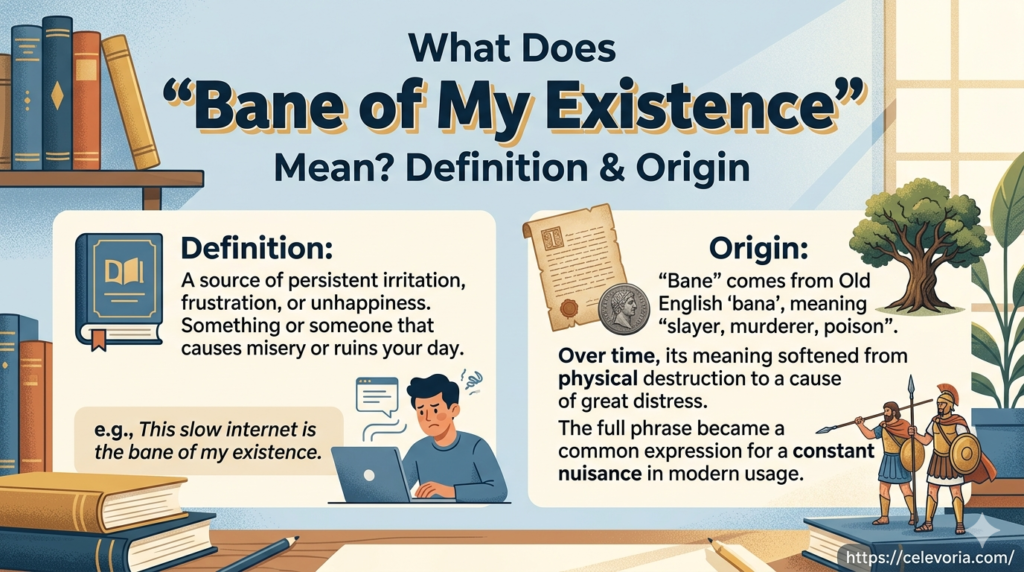

Do you have a slow internet connection during a work crisis? That constant frustration is the absolute bane of my existence. We all face daily annoyages that drain our energy and test our patience. This phrase perfectly captures those recurring headaches that make life difficult. Understanding this idiom helps you express your daily struggles with a touch of dramatic flair. Let us explore exactly what this expression means, where it comes from, and how it shapes our daily conversations.
What is the Definition of “Bane of My Existence”?
The phrase refers to a specific person, object, or recurring situation that causes ongoing misery, irritation, or intense frustration. When you label something as the bane of my existence, you identify it as your ultimate daily annoyance. It is the one thing that consistently disrupts your peace of mind or complicates simple tasks.
While the words sound incredibly severe, people rarely use them to describe actual danger. Instead, the expression functions as a dramatic hyperbole. It helps speakers vent about persistent, nagging problems in a colorful way.
The Historical Origin of the Word Bane
To understand the full phrase, we must look at the linguistic history of its core word. The term “bane” comes from the Old English word bana, which translates directly to a murderer, destroyer, or agent of death. In ancient times, it often referred to deadly poison, which is why toxic plants like wolfsbane or henbane carry the name.
Over many centuries, the word evolved from meaning a literal killer to signifying a source of harm or ruin. Eventually, it softened further into modern English. Today, it describes things that cause psychological distress or extreme annoyance rather than physical destruction.
Why Do People Use This Expression?
Speakers use this idiom because standard words like “annoying” or “frustrating” often feel too weak. Calling a bad habit the bane of my existence adds emotional weight and theatrical flair to a statement. It immediately signals to the listener that the issue is a deeply rooted, recurring problem.
Furthermore, the phrase injects dark humor into mundane situations. It allows individuals to complain about minor inconveniences—like traffic jams or tangled headphone cords—by using language fit for a tragic hero. This exaggeration makes daily venting sessions more engaging and relatable.
Common Everyday Examples of the Phrase
You can apply this expression to almost any minor catastrophe or persistent bother in modern life. Identifying these common triggers helps clarify how the idiom operates in casual speech.
-
Technology Glitches: A printer that jams right before an important meeting becomes the bane of my existence.
-
Household Chores: Putting away clean fitted sheets serves as a weekly source of frustration for millions.
-
Dietary Restrictions: For someone with a sweet tooth, resisting sugar is the ultimate daily battle.
-
Commuting Inconveniences: That one specific traffic light that always turns red right as you approach it.
Pop Culture Impact: The Bridgerton Effect
While the idiom has existed for generations, it experienced a massive global resurgence due to modern television. The phrase became a massive romantic trope following its strategic use in the Netflix series Bridgerton.
“You are the bane of my existence, and the object of all my desires.” — Anthony Bridgerton
This iconic line delivered by the character Anthony Bridgerton flipped the traditional meaning on its head. It combined deep frustration with intense passion, showing how a person can drive you crazy while completely capturing your heart. The quote sparked thousands of internet memes and cemented the phrase into the vocabulary of younger generations.
Grammar and How to Use It in a Sentence
Using this phrase correctly requires treating it as a single, complete noun phrase. It typically follows a linking verb like “is” or “becomes” to describe a specific subject.
-
Correct Structure:
[Subject] + is/becomes + the bane of my existence.
You can easily modify the pronoun to fit different perspectives. For example, you can say “the bane of his existence” or “the bane of their existence” depending on who suffers from the annoyance. Keep the phrasing intact to ensure it retains its idiomatic power.
Synonyms and Alternative Expressions
If you want to vary your language, several other idioms share a similar meaning. These alternatives range from professional to highly casual.
-
Thorn in my side: Implies a constant, sharp irritation that will not go away.
-
Achilles’ heel: Refers to a specific weakness that leads to your downfall, though it focuses more on vulnerability than irritation.
-
Nemesis: Best used when a specific person acts as your ultimate rival or source of trouble.
-
The bane of my life: A common British English variant that means the exact same thing.
The Psychological Value of Labeling Our Frustrations
Psychologists note that naming our stressors actually helps us manage them. When you declare that a messy desk is the bane of my existence, you externalize the problem. You turn a vague feeling of stress into a clearly identified target.
This linguistic habit offers a healthy emotional release. By laughing at the absurdity of how much power a small object or situation holds over your mood, you reduce its actual negative impact on your mental well-being.
How to Deal With the Banes of Your Life
Identifying your primary sources of irritation is only the first step; taking action to eliminate them is the real goal. You can systematically reduce these daily stressors with a few practical adjustments.
-
Analyze the Core Issue: Determine if the problem is a physical object, a broken process, or a difficult relationship.
-
Automate or Replace: If a slow computer is the bane of my existence, saving up for an upgrade directly solves the issue.
-
Change Your Perspective: Accept that certain minor annoyances, like bad weather, are completely outside your control.
Why This Phrase Ranks High in Search Trends
People frequently search for this idiom because language is constantly evolving. Digital communication, social media trends, and viral television moments drive curious readers to look up exact definitions and origins.
By understanding the mechanics behind these search trends, we see that users want straightforward, human-authored explanations. They look for clear context, accurate history, and practical examples rather than robotic definitions.
Conclusion
In conclusion, life will always present us with minor hurdles and repetitive challenges. Whether it is a difficult project, a broken tool, or an early morning alarm clock, something will always claim the title of the bane of my existence. Recognizing these triggers allows us to address them head-on with humor and resilience. By mastering this expression, you gain a powerful tool for self-expression and connection with others who share the exact same daily struggles.
Frequently Asked Questions
What does “bane of my existence” mean in simple terms?
It means something or someone that constantly causes you frustration, annoyance, or unhappiness. It is your biggest daily headache.
Is the phrase “bane of my existence” an insult?
It can be an insult if said seriously to a person. However, people usually use it as a dramatic joke to complain about annoying objects or situations.
Where did the phrase come from?
The word “bane” comes from an old English word for a murderer or poison. Over time, the phrase evolved to mean a major source of mental annoyance.
Can a person be the bane of your existence?
Yes, a person can be the bane of my existence if they constantly cause you trouble, create drama, or make your daily tasks much harder to complete.
What is the opposite of the bane of my existence?
The opposite is “the light of my life” or “my saving grace.” These phrases describe things that bring you pure joy, comfort, and relief.
Why did the phrase become popular on TikTok and Netflix?
The phrase went viral because of a dramatic romantic confession in the show Bridgerton. Millions of fans began using the quote in videos, edits, and everyday captions.