
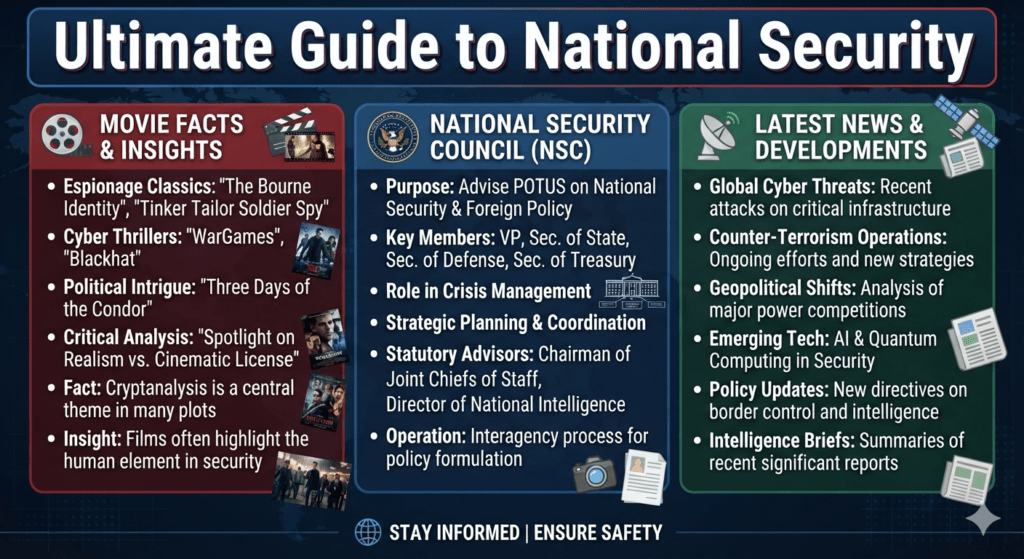

When people talk about safety, the phrase national security often comes up first. But what does it really mean? At its core, keeping a country safe means protecting people from foreign threats, dangerous criminals, and sudden crises. It covers everything from cyber protection and border monitoring to official intelligence operations. Because of its huge importance, the idea appears everywhere in our culture. You see it in high-stakes news headlines, official legal actions, and major Hollywood action-comedy films. Understanding these different areas helps us see how safety measures shape our daily lives, entertainment, and legal systems.
What Is National Security and Why Does It Matter Today?
The basic idea of safety for a nation goes back centuries, but modern society has changed how it works. Today, protecting a nation means safeguarding physical borders, digital networks, financial systems, and public health. Strong protection measures keep communities stable and ensure that everyday businesses operate smoothly without fear of sudden disruption.
Without solid defense strategies, countries risk losing vital infrastructure like electricity grids or sensitive digital networks. Everyday citizens depend on these systems to work, stay informed, and travel safely across borders.
The Famous National Security Movie from 2003
In pop culture, serious topics are often turned into entertaining cinema. A major example is the national security movie released in national security 2003. Directed by Dennis Dugan, this action-comedy takes a humorous look at private guards and police officers getting into big trouble while trying to solve a crime.
Instead of a dark legal thriller, the national security movie brings quick jokes, funny car chases, and non-stop action. Martin Lawrence plays Earl Montgomery, a rejected police academy applicant, while Steve Zahn plays Hank Rafferty, a former police officer who loses his badge after a major misunderstanding.
Key Cast and Characters of National Security 2003
The comedy works so well because of the dynamic chemistry between its lead stars. Martin Lawrence gives a high-energy performance as Earl, a character who always speaks his mind and causes chaotic situations wherever he goes. On the flip side, Steve Zahn plays Hank as the straight-laced guy who just wants to clear his name and rebuild his life.
Their constant bickering creates endless comedic moments throughout the film. Supporting actors like Colm Feore and Eric Roberts play sinister villains, giving the two clumsy heroes a real threat to fight against while exposing a smuggling ring.
The Plot: How Two Mismatched Heroes Team Up
The story kicks off when Hank mistakes Earl’s erratic behavior for a break-in attempt, leading to a heated argument and a bad misunderstanding. As a result, Hank loses his police job and serves time in jail. Once released, he takes a job as a basic security officer, only to run into Earl again at the same guard company.
Despite their past rivalry, the pair accidentally discover a major smuggling operation involving corrupt officers. They must set aside their personal fights and combine forces to expose the conspiracy, safeguard evidence, and clear Hank’s damaged reputation once and for all.
What Is the National Security Council and Its Role?
Moving from movies back to real life, every country relies on specialized teams to manage high-level crises. In the United States, the national security council serves as the principal advisory group for the President regarding top-level foreign affairs and homeland protection strategies.
This important group brings together cabinet members, military generals, and top intelligence officials to review major international developments. They coordinate defense policies across different agencies, ensure effective communication during global emergencies, and help make strategic decisions when critical threats emerge.
Famous Legal Battles: The Judge Leon National Security Ruling
Legal debates surrounding privacy and government power are always intense. A prime example is the landmark judge leon national security ruling from late 2013. Federal Judge Richard Leon made global headlines when he ruled against the National Security Agency’s mass collection of phone data.
Judge Leon declared that the mass collection of citizen phone records was likely unconstitutional under the Fourth Amendment. He argued that modern technology makes phone data far more revealing than in past decades, creating a huge precedent for public privacy rights against federal surveillance programs.
Balancing Public Safety and Personal Freedom
The ruling by Judge Leon highlights an ongoing challenge faced by modern democracies. Leaders must balance public protection against personal privacy rights. If surveillance goes too far, citizens lose fundamental civil liberties; if safety measures are too weak, threats can harm innocent people.
Personal Privacy Rights ◄─────[ Modern Policy ]─────► Public Safety Measures
(4th Amendment Protections) (Balanced Oversight) (Threat Detection)
Finding the right balance requires active legal courts, transparent government actions, and well-regulated surveillance powers. Public oversight ensures that federal programs remain focused solely on preventing genuine danger without stepping on the everyday rights of ordinary citizens.
Modern Cyber Threats to National Security
Physical borders are no longer the only battleground for national safety. Cyber warfare, digital espionage, and massive data breaches now represent major risks to world governments and private businesses. Hackers can attack power grids, steal confidential intelligence, or shut down hospital emergency systems from thousands of miles away.
To counter these technological risks, national safety teams now hire top computer programmers, security engineers, and digital analysts. Protecting sensitive networks is just as important today as maintaining traditional military defense forces on land, sea, and air.
How Entertainment Influences Public Perception of Security
Films, television shows, and pop culture shape how everyday people think about safety agencies. When movies depict guard work as silly or corrupt, it creates a lighthearted view of defense. Conversely, intense spy thrillers make intelligence agencies seem omnipotent and high-tech.
Pop Culture Depictions
├── Action-Comedies (e.g., National Security 2003) —> Humanizes / Satirizes Guard Work
└── Intense Spy Thrillers —> Emphasizes High-Tech Surveillance
These stories help people process complex topics like government surveillance, law enforcement actions, and global politics in an accessible format. Entertainment allows us to explore real-world fears in a safe environment while having fun.
The Future of Global and National Security
Looking ahead, defense strategies will continue to adapt to new technologies like artificial intelligence, automated drones, and advanced space exploration. Global threats now move faster than ever, requiring real-time international cooperation between allied nations.
As long as new risks emerge, nations must upgrade their defense methods, refine their laws, and maintain strict public oversight. Staying informed about both real-world policy updates and cultural depictions helps citizens stay aware and engaged in safety conversations.
Conclusion
From the hilarious antics in the national security movie from national security 2003 to real-life high court decisions like the judge leon national security ruling, this topic touches many parts of modern life. Official agencies like the national security council work hard every day to shield communities from internal and external dangers. By understanding how defense laws, technological updates, and entertainment mix together, we can better appreciate the work required to keep society safe, free, and stable.
(FAQs)
1. What was the main plot of the national security movie from 2003?
The national security movie follows two mismatched security guards—a former police officer and a rejected academy student—who team up to uncover a massive smuggling operation and clear their reputations.
2. Who starred in national security 2003?
The film stars Martin Lawrence as Earl Montgomery and Steve Zahn as Hank Rafferty. They lead an entertaining buddy-cop action comedy directed by Dennis Dugan.
3. What does the national security council do?
The national security council serves as the main team of advisors to the President on foreign policy, military strategy, intelligence operations, and homeland defense matters.
4. Why was the judge leon national security ruling so important?
The judge leon national security ruling was a major legal decision that found the government’s mass collection of phone metadata was likely unconstitutional under the Fourth Amendment, strengthening privacy rights.
5. How do cyber attacks affect national security today?
Cyber attacks threaten vital infrastructure like power networks, digital communications, financial systems, and government records, making cybersecurity a top defense priority.
6. Where can I watch the 2003 movie National Security?
The movie is widely available to stream, rent, or buy on popular digital platforms like Amazon Prime Video, Apple TV, and YouTube Movies.